Marigold Flowers Clipart: Vibrant Botanical Assets for Modern Design
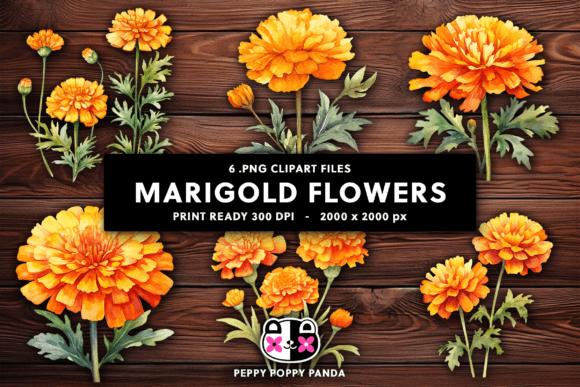
In the world of digital design, finding assets that balance versatility with distinct personality is a constant challenge. Marigold Flowers Clipart enters this space not as just another floral element, but as a curated set of high-quality, transparent PNG files designed for real-world application. This collection offers six distinct marigold compositions, each rendered at a substantial 2000x2000 pixel resolution and 300 DPI. The result is a set of design assets that move seamlessly from screen to print, maintaining crisp detail whether they are scaled down for a social media icon or printed full-size on a poster.
Understanding the Visual Character and Appeal
The Marigold Flowers Clipart set captures the flower's inherent warmth and structured beauty. Visually, these are not overly stylized or abstract; they possess a realistic yet clean aesthetic that feels both approachable and professional. The transparent backgrounds are a critical feature, allowing each bloom to be layered effortlessly over any color, pattern, or photograph without cumbersome editing. This makes them ideal for creating complex compositions quickly. The personality of these cliparts is one of cheerful sophistication—they evoke feelings of positivity, growth, and natural elegance. This makes them exceptionally well-suited for brands and projects aiming to convey friendliness, creativity, or a connection to nature without appearing overly casual or childish.
Where These Floral Assets Truly Shine
The true strength of the Marigold Flowers Clipart lies in its incredible range of applications. For entrepreneurs and designers in the Print on Demand (POD) space, these are ready-made design elements. Imagine them featured prominently on a t-shirt graphic, as part of an all-over pattern for fabric, or as a detailed motif on a phone case. Their high resolution ensures they print beautifully on homeware items like pillows or mugs, where detail is paramount.
Beyond POD, these cliparts are powerful tools for building a cohesive brand identity. A single marigold can become a recognizable element in a logo design, repeated across packaging, or used as a decorative accent on a website. For social media graphics, they can be used to frame text, create engaging Instagram story backgrounds, or add a consistent thematic element to a content calendar. Bloggers and publishers will find them invaluable for enhancing editorial design—they can break up long blocks of text in articles, illustrate points in a guide about gardening or wellness, or add visual interest to an e-book cover. Crafters and hobbyists can import the PNGs directly into Cricut Design Space or Silhouette Studio for creating custom stickers, decals, and paper crafts with precision.
Practical Guidance for Integrating Clipart into Projects
Working with these assets effectively requires a bit of strategic thinking. First, consider the project's overall tone. The Marigold Flowers Clipart works best where its natural energy is an asset. For a serene, minimalist brand focused on muted tones, a single, subtly placed marigold might be more effective than a dense cluster. For a vibrant, creative studio's marketing materials, a bold arrangement could be perfect.
Next, think about visual hierarchy. These are display-level assets—they are meant to be seen. Use them to draw the eye, but be mindful of competing with your primary message. A common technique is to use the clipart as a background layer with reduced opacity, or as a frame that guides the viewer's attention toward central text or a call to action. When pairing with typefaces, contrast is key. The organic, detailed forms of the marigolds pair well with clean, simple sans serif fonts for a modern look, or with elegant serif fonts for a more traditional, sophisticated feel. Avoid pairing them with highly decorative script fonts or handwritten fonts unless the design is intentionally busy, as this can create visual clutter and harm readability.
Evaluate each of the six included designs for its specific strengths. One composition might be a perfect standalone icon, while another, more sprawling arrangement, could be ideal for filling a border or creating a pattern. Test how they look at different sizes—what looks detailed at full resolution might become a blurry blob as a tiny favicon. Always check the final output, especially for print projects. The 300 DPI specification is standard for quality printing, but ensure your print service provider's requirements are met.
Finally, understand the licensing. As commercial font and asset licenses vary, the product details for this premium font clipart set should be reviewed carefully. Typically, such assets allow for use in end products for sale (like POD merchandise or printed planners) but may restrict redistribution of the original source files. Knowing these terms protects your business and ensures you are using these design assets ethically and legally.
A Final Thought on Creative Application
Ultimately, the Marigold Flowers Clipart set is a toolbox. Its value is unlocked not just by its technical specifications, but by how you apply it to solve a design problem or seize a creative opportunity. Use it to add a burst of color to a newsletter header, to create a cohesive pattern for a notebook cover, or to develop a series of printable designs for wall art. The consistency across the six files allows for creating coordinated sets—think matching cards and envelopes, or a social media post and story that share the same visual language. Let the structure and color of the marigold guide you, and you'll find it a versatile ally in producing professional, engaging, and visually cohesive work.